Use this when
Adoption and trust are unclear
Use this route when uptake is weak, trust is fragile, completion is inconsistent, or user behavior cannot be explained through interface review alone.
UX Lab Service
Behavioral and contextual research to understand needs, barriers, and trust drivers across diverse user groups and complex stakeholder environments.
Decision fit
Human-Centered Research helps teams understand people, contexts, behaviors, and service barriers before making product, program, or rollout decisions. It is useful when adoption, trust, inclusion, or real-world use cannot be explained through interface review or task validation alone.
Operational logic
Use this route when the core decision is about behavior, trust, inclusion, or service reality, not only interface quality or task completion.
Use this when
Use this route when uptake is weak, trust is fragile, completion is inconsistent, or user behavior cannot be explained through interface review alone.
Primary output
Organizations receive synthesized evidence about barriers, trust conditions, context, and user differences that shape product or service outcomes.
Choose another route
If the main need is structured assessment of the interface and critical flows, use Product UX Evaluation.
Product UX Evaluation →Choose another route
If the main need is to observe whether users can complete specific flows successfully, use Usability Testing & Validation.
Usability Testing & Validation →Service boundary
This route focuses on understanding behavior in context. It may use qualitative or mixed methods, but the scope is defined by the decision to support, not by maximizing method count.
Scope
The research scope is defined around the question the team needs to answer: why users adopt, avoid, misunderstand, mistrust, or struggle with a product, platform, or service.
Scoping note
Methods may include interviews, contextual inquiry, participatory sessions, or mixed-method sequencing, but the scope is defined by the decision to support, not by method volume.
Process
The process is structured to reduce ambiguity, protect participants, and produce outputs that can guide product, program, and service decisions.
Clarify what must be understood: adoption barriers, trust gaps, inclusion issues, or implementation risk.
Define who should be included, which contexts matter, and what evidence is needed to support accountable decisions.
Observe and document how people interpret, navigate, accept, avoid, or work around the service in realistic conditions.
Group findings into themes that explain what is happening, why it matters, and where the highest-impact improvement opportunities lie.
Deliver actionable direction for redesign, implementation adjustment, further validation, or governance-aware rollout planning.
Process note
Fieldwork, interviews, participatory inquiry, and mixed-method sequencing may all be appropriate, but the process remains anchored to the decision the organization must make.
Outputs
Outputs are written for teams that need clarity, prioritization, and implementation direction, not only research documentation.
Insight summary
Decision and implementation direction
Need to align scope first?
When the decision question, user scope, or operational context is still being clarified, a consultation can help define the most appropriate research route.
Book a consultationGovernance
Governance is essential in field-grounded work. It protects participants, supports credibility, and reduces risk in sensitive or regulated contexts.
Case example
These examples show how field-grounded research surfaces real constraints and translates them into usable direction for teams.
Case example
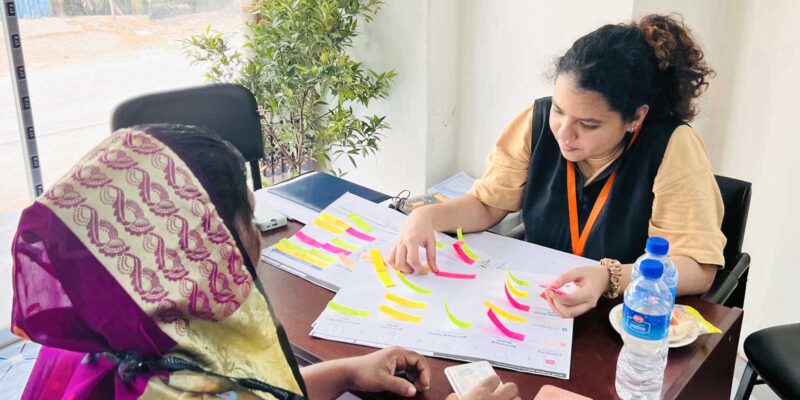
When services affect money, privacy, or identity, research must go beyond interface issues alone. This case illustrates how behavior, trust, and contextual constraints can be investigated to explain hesitation, avoidance, and adoption barriers.

Case example
In field and community settings, service success depends on more than interface quality. This case shows how stakeholder realities, local norms, and operational constraints can be synthesized into practical implementation direction.
What these cases demonstrate
FAQ
Short answers for teams evaluating whether research is the right starting point and what it can support.
Request
Share the product, service, or program context; the user groups you need to understand; and the adoption, trust, inclusion, or rollout question you are trying to answer.
This route is suitable when the central question is not only what should be redesigned, but why people are not adopting, trusting, or engaging with the service as intended.