UX Lab Case Record
Human-Centered WASH Demand Creation Strategy in Bangladesh
A UX Lab case record on developing a human-centered WASH demand creation strategy for Simavi and WASH Alliance International, using field research, personas, gap analysis, communication-material testing, and partner training across Satkhira and Barguna.

Context
The WASH SDG Programme in Bangladesh was part of a wider international effort to improve sustainable access to sanitation, hygiene practices, and safe drinking water. The programme worked across six municipalities and two upazilas in Satkhira and Barguna, with local and international partners supporting community-level WASH outcomes.
Simavi, as the lead implementing partner for the WASH Alliance International sub-programme in Bangladesh, assigned Userhub to support the development and implementation of a demand creation strategy. The strategy needed to motivate specific WASH-related behavior changes while remaining grounded in the realities of community life, local decision-making, gender dynamics, social exclusion, disability inclusion, and partner implementation capacity.
This case represents one of Userhub UX Lab’s major field-based human-centered research engagements. The work moved beyond communication planning alone. It combined qualitative research, persona development, gap analysis, behavior-change framing, prototype testing, message refinement, and partner capacity development into a single applied strategy process.
Objectives
The primary objective was to develop and support the implementation of a demand creation strategy that could motivate desired WASH behaviors among community members in Bangladesh.
The strategy focused on four behavior areas: household investment in sustainable WASH products and services; improved personal and environmental hygiene practices; participation of women, people with disabilities, and socially excluded groups in WASH-related decision-making; and greater involvement of men and boys in household care responsibilities.
A further objective was to translate field evidence into practical communication logic. The work needed to identify what motivates people, what barriers limit behavior change, which influencers matter, which channels are appropriate, and how local partners could use the strategy in implementation.
Research Design
Userhub followed a human-centered design process supported by the FOAM behavior-change framework, which examines focus, opportunity, ability, and motivation. This combination allowed the team to study both lived experience and the behavioral conditions that shape WASH-related decisions.
The assignment was carried out through four connected phases: empathize and define, ideate and prototype, test and refine, and support in implementation. Each phase converted evidence into a more actionable form: field data became personas, personas informed strategy, strategy became communication materials, and tested materials informed implementation guidance.
This design was important because demand creation depends on more than awareness. People may know that improved sanitation, hygiene, or menstrual health practices are important, but still face barriers related to cost, habit, social norms, family decision-making, stigma, access, confidence, or lack of trusted guidance.
Fieldwork
The field research included qualitative interviews with 540 participants across eight locations in Satkhira and Barguna. In Satkhira, the study covered Satkhira Sadar, Satkhira Municipality, and Kalaroa Municipality. In Barguna, the study covered Barguna Sadar and the municipalities of Barguna, Amtali, Betagi, and Patharghata.
The study included community members, women, men, children, people with disabilities, socially excluded groups, local government institution representatives, WASH entrepreneurs, and WAI partner representatives. This allowed the strategy to reflect both household-level behavior and the wider institutional environment that supports or constrains change.
At the end of the initial research phase, Userhub synthesized the evidence into eight personas. These included community personas such as a man, a woman, a boy, a girl, a socially excluded community member, and a person with disability, along with influencer personas such as a religious leader and a teacher.
The persona system helped translate a large body of qualitative evidence into an implementation-ready strategy. Instead of treating the community as a single audience, the strategy recognized that different people respond to different motivations, channels, barriers, and forms of social influence.
Evidence Areas
The research identified several evidence areas that shaped the final strategy. These included household investment decisions, privacy and security concerns, child health, menstrual hygiene, social status, disability inclusion, participation in family and community decisions, and the role of men and boys in household care work.
For household investment in WASH products and services, the strategy recognized that health messages alone were not always sufficient. Motivational triggers such as child well-being, family security, privacy for women and children, social respect, and improved household status were important for encouraging investment in improved sanitation and hygiene products.
For hygiene and menstrual health, the evidence showed the need for clearer, more open, and more practical communication. The strategy treated menstrual hygiene not only as an individual issue, but as a family and community issue shaped by taboo, parental awareness, access to products, and the confidence of girls and women to discuss their needs.
For women, people with disabilities, and socially excluded groups, the strategy emphasized awareness, self-efficacy, rights, and participation in decision-making. This required communication approaches that could build confidence while also involving families, local authorities, NGOs, and community influencers.
For men and boys, the strategy framed household participation as a positive social behavior. It emphasized care, responsibility, respect, and family well-being rather than presenting household chores only as an obligation.
Userhub also reviewed existing partner communication materials and strategies through gap analysis workshops and literature review. This helped identify where current approaches were working, where they needed refinement, and how future messaging could become more targeted, inclusive, persuasive, and easier for local partners to implement.
Testing and Refinement
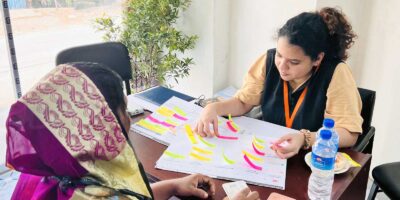
Userhub tested example communication materials with community participants in Barguna and Satkhira. Six focus group discussions were conducted, with 36 participants representing men, women, socially excluded groups, people with disabilities, school-going girls, and school-going boys.
The testing examined whether the materials were understandable, identifiable, persuasive, attractive, and acceptable. Participants responded to example posters and messages, allowing the research team to assess whether the strategy’s communication logic worked in real community settings.
The testing phase was important because it prevented the strategy from remaining only a planning document. Community responses helped refine the messages, illustrations, and communication approach before the strategy was finalized for implementation.
Evidence from the testing confirmed that messages were stronger when they connected with recognizable family roles, practical needs, dignity, responsibility, and social context. It also showed that small changes in visuals, wording, settings, and character representation could affect comprehension and acceptability.
Outputs
The engagement produced a set of implementation-oriented outputs, including community personas, a gap analysis and review report, a demand creation strategy, tested communication-message examples, a communication-material testing report, and training support for local WAI partners.
The final demand creation strategy included desired behavior sets, target audiences, guiding principles, communication approaches, persona-based messaging logic, recommended channels and formats, example poster messages, example radio messages, campaign planning guidance, and monitoring and evaluation considerations.
As the final phase of the engagement, Userhub supported implementation readiness through an online training programme for WAI local partners. The training introduced human-centered design, behavior-change communication, the FOAM framework, persona-based strategy logic, campaign planning, prototyping, quality checking, monitoring, evaluation, and iteration.
The training included representatives from organizations involved in local implementation, including WaterAid, Uttaran, DORP, SLOPB, Practical Action, Hope for the Poorest, Simavi, and Userhub. The purpose was to help partner teams understand how to use the strategy in their own field contexts rather than treating it as a static document.


Contribution
The project demonstrates how human-centered design can support public health and development programmes when behavior change depends on trust, motivation, social norms, and local implementation capacity.
Userhub’s contribution was to connect field evidence with practical strategy. The research did not stop at documenting barriers. It translated those barriers into personas, motivational triggers, communication principles, message examples, channel recommendations, testing evidence, and training support.
The engagement also shows why inclusive strategy development requires multiple layers of evidence. Household interviews, partner workshops, focus group discussions, material testing, and implementation training each revealed a different part of the system. Together, they helped create a strategy that was more grounded, more actionable, and more adaptable for local partners.
For Userhub UX Lab, this case remains an important example of field-grounded human-centered research for international development. It shows how research, strategy, prototyping, testing, and capacity building can work together to support complex social and behavioral change.
Conclusion
The WASH demand creation strategy project used human-centered research to understand how communities in Satkhira and Barguna perceive sanitation, hygiene, menstrual health, inclusion, decision-making, and household responsibility.
The final strategy was built through a sequence of evidence-based steps: qualitative field research, persona synthesis, partner gap analysis, behavior-change strategy development, community testing, message refinement, and implementation training.
The case highlights a central lesson for development-sector communication: effective demand creation cannot rely only on information delivery. It must connect with people’s motivations, constraints, social roles, trusted influencers, and everyday decision-making environments.
By combining human-centered design with behavior-change strategy, Userhub helped convert community evidence into an implementation-ready framework for WASH partners working toward sustainable and inclusive behavior change in Bangladesh.
Disclaimer
This case study summarizes a project conducted by Userhub for Simavi and WASH Alliance International. It is based on information suitable for public institutional documentation. Participant identities, raw field data, private contact details, and non-public operational materials have been excluded.