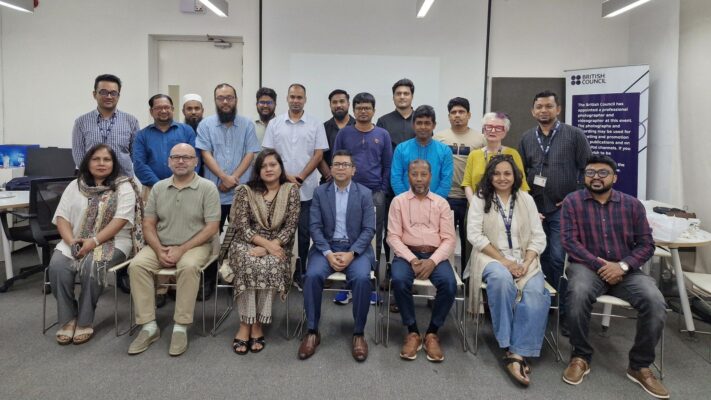
Dhaka, 15 November 2026. Wahid bin Ahsan, Co-founder and Managing Director of Userhub, presented “Beyond Access and Usability: Human-Centred Design for Inclusive Public Services” at the 5th Dhaka Service Design Community Meetup, held at the British Council, Fuller Road, Dhaka, on 14 November 2026. The presentation examined how human-centered design can help public-service teams understand citizens’ experiences before, during, and after using digital services.
The meetup brought together professionals working in government agencies, public service delivery, technology, and service design. Md Akter Ali, Senior Systems Analyst at Bangladesh Police Headquarters, also presented on the development of the online police clearance service. The presentations were followed by discussions with participants.
“A public service begins before the portal and ends after the transaction.”
Wahid bin Ahsan, Beyond Access and Usability presentation
Human-Centered Design Across the Service Journey
The presentation explored why access to a digital public service and successful interaction with its interface do not necessarily mean that citizens achieve their intended outcomes. Drawing on ISO 9241-210:2019, bin Ahsan emphasized that human-centered design considers the complete user experience, including people’s needs, expectations, interactions, and experiences after a service decision.
The talk connected three stages of the service journey with complementary research approaches: user research to understand people’s needs and circumstances before using a service; usability testing to identify difficulties and differences between users’ expectations and service processes; and follow-up research to understand citizens’ experiences after a service decision.
A central point was the difference between what service teams can observe internally and what citizens experience. Administrative systems may record applications submitted, processed, and disposed of, but these records may not reveal people who never applied, abandoned the process, or depended on assistance elsewhere. Understanding these experiences requires engaging directly with people, including those who are difficult to reach.
Research Methods and Practical Applications
To illustrate research approaches, the presentation referenced Userhub’s 2025 qualitative fieldwork with approximately 50 women garment workers in Dhaka, Narayanganj, and Gazipur, conducted as part of baseline research for an evaluation led by Dalberg Design for BRAC. The work demonstrated a research approach that engages participants in their everyday contexts rather than relying exclusively on digital service records.
The talk also distinguished expert accessibility assessments from usability testing with participants. Examples included an accessibility audit of 47 Bangladeshi government e-services and two rounds of usability testing with 33 online shoppers using e-commerce prototypes. Together, these examples illustrated different ways to identify barriers, examine user behavior, and inform design improvements.
The presentation concluded with a practical starting point for service teams: ask five people to read a message sent by a service and explain what they would do next. Their responses can help identify where instructions need further investigation and testing.
Related Research and Services
The presentation builds on Wahid bin Ahsan’s Insights article, Digital Inclusion Is More Than Access and Usability, which examines why digital inclusion must be considered beyond access and interface usability.
Userhub UX Lab supports international teams and organizations through Human-Centered Research, qualitative fieldwork, and Usability Testing & Validation in Bangladesh. Its work includes research on digital services, accessibility, and people’s experiences with technology.
Organizations planning research or UX evaluation for public, financial, or development-sector digital services can discuss their requirements with Userhub UX Lab.