UX Lab Case Record
BRAC Agami and Digital Financial Engagement Among Women RMG Workers
A UX Lab case on baseline qualitative research connected to BRAC Agami, examining women ready-made garment workers’ financial lives, digital confidence, and engagement with digital financial services.
Context
This case study documents Userhub’s role in baseline qualitative research connected to BRAC Agami, a BRAC digital microfinance platform. The work examined women ready-made garment workers’ financial lives, digital confidence, mobile financial service use, and engagement with digital financial services in Bangladesh.
Women working in Bangladesh’s ready-made garment sector increasingly encounter digital financial services through wage digitization, mobile financial services, loan repayment systems, savings behavior, and app-based financial platforms. Yet access to digital channels does not automatically translate into confident or sustained use. Digital literacy, phone access, household decision-making, trust, transaction costs, agent dependence, and concerns around fraud all shape how women engage with digital finance.
The broader impact evaluation was led by Dalberg for BRAC and examined women RMG workers’ financial lives, awareness and use of Agami, barriers to adoption, and early signals related to financial resilience, agency, confidence, and digital capability. Userhub UX Lab supported the qualitative research workstream by translating the evaluation framework into field-ready research practice while protecting participant privacy and maintaining role clarity within a multi-partner research ecosystem.
Objectives
The research was designed to understand how women RMG workers manage money, make financial decisions, and engage with digital and non-digital financial systems in everyday life. It examined income, expenses, savings, borrowing, loan repayment, aspirations, household decision-making, mobile phone access, and use of mobile financial services.
A second objective was to explore awareness, uptake, confidence, and use of the Agami platform among active users, dormant users, non-users, and potential users. The research examined how workers first learned about the platform, how they understood its services, what support they needed, and what barriers shaped adoption or non-use.
The study also explored early signals related to financial resilience, agency, confidence, digital capability, and perceived control over money. This included attention to risks and constraints such as fraud concerns, privacy, data cost, connectivity, family norms, and reliance on agents or family members for digital transactions.
Methodology
Userhub supported a human-centered qualitative research process aligned with Dalberg’s evaluation framework and learning agenda. The research used in-depth interviews, small group discussions, and participatory tools to capture financial practices, digital behaviors, platform journeys, and before-and-after perceptions of digital financial engagement.
For organizations commissioning research on digital financial inclusion, this work illustrates how qualitative UX and human-centered research can support evaluation design, field implementation, participant-sensitive inquiry, and synthesis in complex development-sector contexts.
The fieldwork was structured around three learning themes: women workers’ financial lives and digital behaviors; awareness, uptake, and confidence in using Agami; and the platform’s potential role in financial resilience, agency, and longer-term digital financial engagement.
The research process included preparation, tool review, pilot testing, baseline fieldwork, documentation, transcription, translation, thematic structuring, and synthesis support. Userhub also participated in learning and feedback sessions to refine research tools and ensure that the approach remained practical, culturally grounded, and suitable for field conditions.
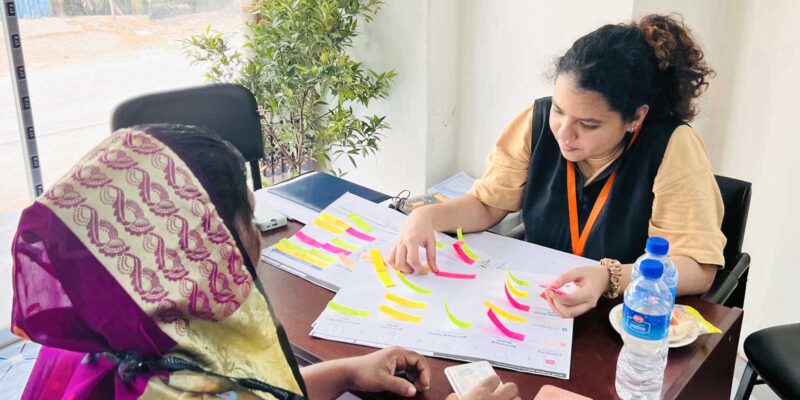
Participatory tools helped participants describe financial behavior in concrete terms. Financial-life mapping explored income streams, expenses, savings, borrowing, repayment, aspirations, decision-making, and movement between cash and digital channels. Show-and-tell and journey mapping supported observation of platform awareness, onboarding, confidence, support needs, and barriers to sustained use.
The work was supported by a structured field documentation system. Research teams shared daily check-ins covering field progress, locations visited, session types completed, participant profiles, smartphone and MFS familiarity, emerging learning moments, consent-based media, and notable observations connected to the learning themes.
Location-level check-ins were used to review emerging learnings, assess whether tools were working with the community, identify barriers to participant engagement, and align next steps before moving into subsequent field locations.
Participants
The qualitative workstream involved approximately 50 women RMG workers across Dhaka, Narayanganj, and Gazipur. The sample was designed to include active Agami users, dormant users, non-users, and potential users, with attention to differences in smartphone access, digital literacy, age, education, household context, and financial behavior.
The participant profile was important because the research did not treat digital financial engagement as a simple product-use question. It examined how financial behavior is shaped by work conditions, household responsibilities, social expectations, literacy, device access, trust, support networks, and everyday constraints faced by women workers.
Ethics and Documentation
The research followed consent-aware documentation practices. Field media was limited to approved contexts, participant identities were protected, and public-facing materials do not disclose identifiable participant details, raw transcripts, factory-level information, or confidential evaluation findings.
The documentation process emphasized human review of field materials to preserve nuance, tone, and participant meaning. This was particularly important because the research involved low-income women workers discussing financial behavior, household decision-making, digital confidence, and perceived risks around financial services.
Public images used in this case study are selected to show research practice without exposing confidential data. Participant identities are protected, and no personal financial information, factory-identifiable detail, or unpublished evaluation finding is shown.
Findings
This public case record does not disclose confidential evaluation findings, participant quotes, or participant-identifiable data. Instead, it summarizes the evidence areas the qualitative workstream was designed to document.
The research generated structured qualitative evidence around financial lives, cash and digital transaction patterns, phone and internet use, MFS familiarity, awareness and perception of Agami, onboarding experiences, use and non-use barriers, support needs, and perceived risks around digital financial services.
The financial-life component examined how women workers understood and managed income, expenses, savings, borrowing, loan repayment, aspirations, and financial decision-making. It also explored how wage digitization and mobile financial services interacted with cash-out behavior, emergency savings, debt repayment, and control over money.
The Agami-focused component examined how participants became aware of the platform, what they understood about its services, which use cases felt relevant, what support they needed during onboarding, and what factors shaped continued use, dormant use, or non-use.
The impact-oriented component explored early signals related to financial confidence, agency, resilience, digital capability, and perceived control over money. It also considered potential risks and barriers, including fraud concerns, privacy, connectivity limitations, data cost, transaction cost, and social norms around women independently managing financial services.
Discussion
The case demonstrates why digital financial inclusion requires more than access to an app or mobile wallet. For low-income women workers, adoption is shaped by the relationship between product design, financial literacy, social permission, trust, support systems, device access, and confidence in handling money independently.
The research design was useful because it connected financial behavior with digital behavior. Instead of asking only whether participants used a platform, the study explored how money was earned, stored, borrowed, spent, repaid, discussed, and controlled within everyday life. This helped position digital service engagement within the wider financial ecosystem of workers and households.
The use of participatory tools helped make abstract financial topics easier to discuss. Mapping income, expenses, savings, borrowing, aspirations, app journeys, and before-and-after perceptions allowed participants to explain their experiences in practical terms rather than only responding to direct questions.
The case also demonstrates how Userhub UX Lab supports complex evaluation environments where the research output is not only a report, but a disciplined process of field preparation, ethical participant engagement, daily documentation, translation, thematic structuring, and synthesis support. For research commissioners, the value of this approach is in helping decision-makers understand how digital financial services fit into the real financial lives of women workers.
For Userhub UX Lab, the engagement shows the value of field-grounded human-centered research in complex development contexts. It also demonstrates Userhub’s ability to work within a multi-partner evaluation ecosystem while maintaining role clarity, ethical field practice, documentation discipline, and contextual interpretation.
Recommendations
The case points to several broader design and evaluation implications for digital financial platforms serving women workers. Product teams should evaluate digital financial tools not only through feature adoption, but also through confidence, comprehension, support needs, household decision-making, trust, and the practical conditions under which women access and use phones.
Digital onboarding should account for different levels of literacy, smartphone access, prior experience with mobile financial services, and reliance on agents or family members. Support systems should be designed around the actual contexts in which women learn, ask for help, recover from mistakes, and decide whether a platform is safe to use.
Evaluation frameworks should combine behavioral, contextual, and perception-based indicators. Metrics such as app awareness, frequency of use, digital confidence, independent operation, savings behavior, repayment behavior, fraud awareness, and control over digital money can provide a more complete picture of meaningful engagement.
Future qualitative work should continue to include active users, dormant users, non-users, and potential users. This allows teams to distinguish between barriers to first-time adoption, barriers to sustained use, and barriers that emerge from broader social, financial, or infrastructural constraints.
Conclusion
This baseline qualitative research case illustrates how digital financial engagement among women RMG workers is shaped by financial practices, digital confidence, social context, platform comprehension, and trust. The research helped examine not only whether women could access digital services, but how those services fit into their everyday financial lives.
Userhub’s role focused on field implementation, participant engagement, documentation, translation, thematic structuring, and synthesis support. The engagement demonstrates the UX Lab’s capacity to support donor-grade and evaluation-oriented research while protecting participant privacy and maintaining a public-facing record that does not disclose confidential findings.
For organizations designing financial products for low-income and marginalized communities, the case reinforces a central human-centered lesson: meaningful adoption depends on the fit between service design, user capability, trust, household context, and the realities of everyday financial decision-making.
Disclaimer
This case study documents Userhub’s role as a qualitative research implementation partner in a baseline research workstream connected to BRAC’s Agami platform. The broader impact evaluation was led by Dalberg for BRAC. Evaluation findings, interpretations, and conclusions are owned by the commissioning and lead evaluation partners. No confidential data, participant-identifiable information, unpublished findings, raw transcripts, internal field notes, or non-public stakeholder discussions are disclosed on this page.