UX Lab Case Record
UX Redesign for Ek Sheba Nagorik Government Services Platform
A UX Lab case record on redesigning the user experience of Ek Sheba Nagorik, a national government services platform, through information architecture, service discovery, application-flow, unified-login, and dashboard design improvements.

Background
Ek Sheba Nagorik was designed as a single digital gateway for government services in Bangladesh. The platform aimed to help citizens find services, apply to the relevant department, submit required information and attachments, and monitor application progress through a personal dashboard.
Userhub worked in collaboration with a2i (Access to Information), a Government of Bangladesh programme focused on citizen-friendly public service innovation. The objective was to improve the user experience of a national-level service platform that needed to support diverse citizen groups, business users, and government officials.
The design challenge was significant. The platform included more than 1500 government services across many public-service domains. Users needed to identify the right service, understand eligibility and required documents, complete an application process, and track their progress. A scalable information architecture and accessible interaction model were therefore central to the redesign.
Objectives
The project aimed to redesign the Ek Sheba Nagorik experience so that citizens could find, understand, and apply for government services more easily.
The core objectives were to improve service categorization, strengthen search and service discovery, simplify application workflows, create a more coherent login experience, and redesign the user dashboard so that citizens could monitor applications, manage information, and receive updates from a single place.
A further objective was to create a design structure that could support different user groups without fragmenting the experience. This required a platform-level information architecture rather than isolated page-level redesigns.
Methodology
Userhub followed a human-centered design process that combined stakeholder engagement, requirement analysis, information architecture, wireframing, visual design, and high-fidelity prototyping.
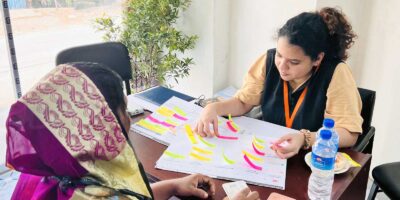
The process began with product stakeholder discussions and design workshops with the a2i team to understand the platform objectives, service structure, user groups, and operational constraints. Userhub then analyzed the existing experience to identify barriers in service discovery, application flow, dashboard organization, and account access.
The redesign moved through several design stages: planning, analysis, information architecture, sketching, wireframing, visual design, and prototyping. The final prototype was designed to emulate the intended experience and support task-based review of key citizen journeys.
Evidence Areas
The evaluation identified several experience problems in the existing platform. Service categories were difficult to scan, search was not visually prominent, search results were not organized clearly, and the path from finding a service to submitting an application required substantial user effort.
Service discovery became one of the central evidence areas. Userhub proposed an audience-based categorization model using three primary user groups: General Citizens, Businesses, and Government Officials. This helped make the large service directory easier to interpret and reduced reliance on users already knowing the correct administrative category.
The search experience was redesigned to make the search box more visible and useful. Search results were reorganized so that users could review services by audience category and understand the relevant department associated with each service.
The service detail page was also redesigned. Instead of focusing mainly on the procedure for filling out a form, the revised page helped users understand essential information before starting an application, including required documents, fees, processing time, and service-specific details.
The application process was simplified by breaking a long form into clearer sections. The redesigned flow separated personal information, service-specific information, and final review so that users could progress through the application in a more structured way.
The login and dashboard experience were redesigned to support a more unified platform model. The proposed login system allowed citizens and government officials to access services through the same platform, while the dashboard brought together profile information, attached documents, application status, notifications, and service activity.
Outputs
The project produced a redesigned user experience for the Ek Sheba Nagorik platform, including revised information architecture, audience-based service categorization, improved search interaction, redesigned search results, service detail page layouts, application-flow screens, registration and login interfaces, dashboard concepts, visual design, and a high-fidelity prototype.
The new design emphasized service discovery, task completion, and dashboard clarity. Users could search for services more easily, understand service requirements before applying, move through forms in smaller steps, and track their applications through a more organized personal dashboard.
The redesign also provided a clearer platform structure for future development. By organizing services around user groups and topics, the platform could better support a wide range of government services without relying only on administrative or departmental logic.
Contribution
This case is important because it shows how UX design can support public-service access at national scale. The work was not limited to visual redesign. It addressed the structure of service discovery, the cognitive load of long application flows, the relationship between citizen and official access, and the need for a dashboard that could support ongoing service use.
For Userhub UX Lab, the project demonstrates applied capability in government digital service redesign, information architecture, service-flow simplification, and prototype-based design delivery. It also reflects Userhub’s long-term focus on making complex digital services more understandable and usable for diverse public audiences.
The engagement remains relevant to current public-sector digital transformation because many government platforms face similar challenges: large service inventories, mixed user groups, complex eligibility requirements, fragmented service journeys, and the need to make digital access understandable for citizens with different levels of digital confidence.
Conclusion
The Ek Sheba Nagorik UX redesign addressed a central challenge in public digital service delivery: helping citizens find and complete government services through a platform that is clear, scalable, and task-oriented.
Userhub’s redesign improved the platform structure through audience-based categorization, stronger search visibility, clearer service details, simplified application steps, unified login direction, and a more usable dashboard experience.
The case shows that effective public-service UX depends on more than interface polish. It requires information architecture, workflow clarity, accessible content hierarchy, and design decisions that reflect how citizens actually search for, understand, and complete services.
Disclaimer
This case study summarizes UX design and redesign work conducted by Userhub in collaboration with a2i for the Ek Sheba Nagorik platform. It is based on information suitable for public institutional documentation. Internal project materials, non-public stakeholder discussions, and sensitive operational details have been excluded.