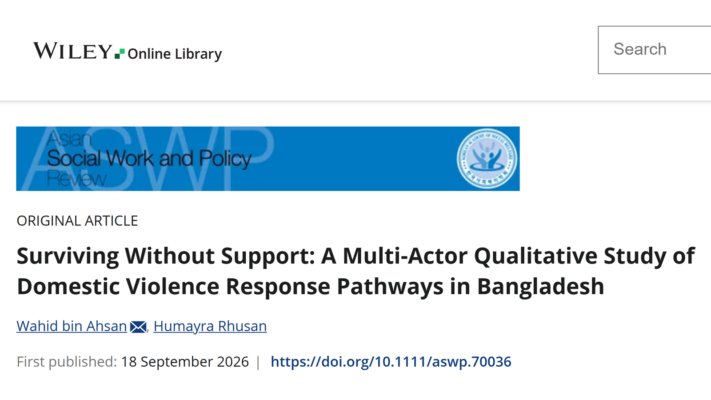
A Userhub-led study by Wahid bin Ahsan and Humayra Rhusan has been published in Asian Social Work and Policy Review, a Wiley journal, examining domestic violence response pathways in Bangladesh.
The article, “Surviving Without Support: A Multi-Actor Qualitative Study of Domestic Violence Response Pathways in Bangladesh,” examines why domestic violence can persist even when family, NGO, legal, and police support systems are available. It focuses on how support pathways can stall or break down as survivors move between informal and formal sources of assistance.
Peer-reviewed publication in Asian Social Work and Policy Review
The article was first published online on 18 September 2026 in Asian Social Work and Policy Review, an international peer-reviewed journal published by Wiley. The study contributes to research on domestic violence response, help-seeking, social support, and institutional pathways by examining how different forms of assistance interact over time.
The permanent article link is available through the DOI: https://doi.org/10.1111/aswp.70036.
A multi-actor qualitative study of domestic violence response in Bangladesh
The study uses a multi-actor qualitative design based on interviews with 15 participants in Chattogram, Bangladesh. The sample included six adult women survivors of domestic violence, two family respondents, three NGO or frontline professionals, two lawyers, and two police officials.
Using thematic analysis, the researchers examined how survivors and other actors described help-seeking, informal mediation, organizational assistance, legal processes, police engagement, withdrawal from support, and later re-engagement.
Rather than treating help-seeking as a single decision or event, the study examines domestic violence response as a pathway in which earlier experiences, institutional constraints, economic conditions, and responsibilities toward children can shape what options remain possible at later stages.
Where domestic violence support pathways break down
The findings identify recurring breakdowns across family, community, NGO, legal, and police support pathways. These included economic precarity, informal mediation without effective enforcement, temporary or conditional assistance, evidentiary and procedural barriers, and gaps in sustained protection.
The study shows that the presence of support does not necessarily produce a continuous pathway toward safety. Assistance may be available at one stage but insufficient, temporary, difficult to access, or disconnected from what happens next.
The analysis also shows that survivor endurance, withdrawal, and later re-engagement with support can reflect strategic responses to cumulative economic, relational, institutional, and safety risks rather than passive acceptance of violence.
Domestic Violence Support Breakdown Model
The article introduces the Domestic Violence Support Breakdown Model (DV-SBM), an evidence-led, process-oriented analytic heuristic developed from the study’s findings.
DV-SBM brings together recurring points of interruption across domestic violence response pathways and shows how breakdowns at one stage can affect the choices and resources available at later stages. The model highlights the cumulative effects of partial, temporary, or poorly coordinated interventions across multiple support systems.
The authors present DV-SBM as an analytic heuristic rather than a predictive or universal model. Its purpose is to support analysis of how support pathways operate, where they fail, and how those failures can accumulate over time.
Contribution to Userhub’s research record
The publication adds an externally peer-reviewed social research article to Userhub’s research record. It combines multi-actor qualitative evidence from Bangladesh with a clearly bounded analytical contribution focused on the processes through which institutional and informal support can break down.
The study reflects Userhub’s broader research emphasis on understanding complex human and institutional systems through empirical evidence, with attention to how real-world processes shape outcomes for the people who depend on them.
Article citation and DOI
bin Ahsan, W., & Rhusan, H. (2026). Surviving Without Support: A Multi-Actor Qualitative Study of Domestic Violence Response Pathways in Bangladesh. Asian Social Work and Policy Review. https://doi.org/10.1111/aswp.70036
Read the article on Wiley Online Library: Surviving Without Support.