Userhub supported a baseline qualitative research workstream connected to BRAC Agami, BRAC’s digital microfinance platform, in a Dalberg-led evaluation context. The research examined digital financial engagement among women ready-made garment workers in Bangladesh.
Women working in Bangladesh’s ready-made garment sector increasingly encounter digital financial services through wage digitization, mobile financial services, loan repayment systems, savings behavior, and everyday household financial decisions. Their ability to use these systems is shaped not only by access to financial products, but also by confidence, phone ownership, shared-device constraints, agent dependence, transaction costs, privacy concerns, and trust in digital processes.
The research focused on women RMG workers across Dhaka, Narayanganj, and Gazipur. It explored financial lives, savings, borrowing, repayment behavior, phone access, digital confidence, awareness and use of Agami, and barriers to sustained digital financial engagement.
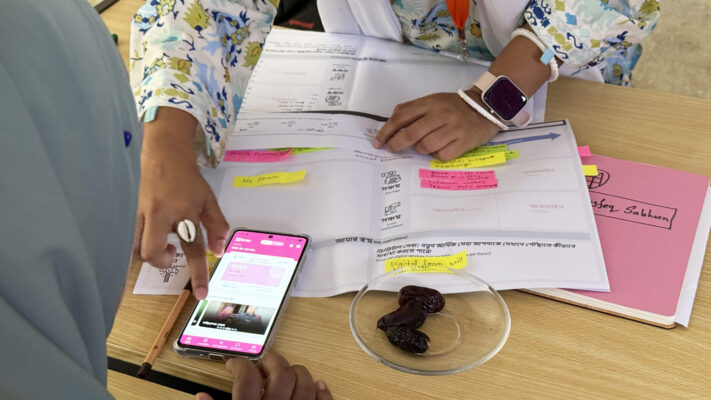
Userhub contributed human-centered qualitative research support for the baseline study. The field process included in-depth interviews, small group discussions, and participatory tools such as financial-life mapping and platform journey mapping with women RMG workers.
The engagement is documented in the related UX Lab case record: BRAC Agami and Digital Financial Engagement Among Women RMG Workers. This case record provides a fuller account of the research context, participant group, methodology, field process, findings, and institutional relevance.
The research approach helped connect digital product use with the wider financial realities of women workers. Rather than treating adoption as a simple app-use question, the study examined how financial behavior, household decision-making, digital capability, service support, and everyday constraints shape sustained engagement with digital financial services.
The assignment reflects Userhub UX Lab’s work in field-grounded Human-Centered Research for digital financial inclusion, gender-sensitive research, and evaluation-oriented learning in Bangladesh.
Organizations designing financial, public-service, or development-sector digital systems can request a UX Lab consultation to understand how people adopt, interpret, and navigate services in real-use contexts.