E-Commerce Returns and Refunds: From Return Availability to Recovery Legibility in Two Prototype Evaluations
Abstract
This study examines how users interpret post-purchase return and refund pathways during e-commerce interaction, focusing on the distinction between a recovery mechanism being available and users being able to understand, act within, and monitor that mechanism. Two sequential prototype evaluations involved 33 adult Bengali-speaking online shoppers, primarily based in Bangladesh. Study 1 (n = 18) examined interaction across product listing, product detail, transaction, and return tasks, while Study 2 (n = 15) evaluated a subsequent prototype iteration with an independent cohort. Moderated task interaction, think-aloud accounts, and post-task interviews provided the primary qualitative evidence, while stage-wise 1–7 trust or confidence ratings were analysed descriptively. Study 1 showed that a return function could be present without being readily discoverable or sufficiently interpretable during use. Across the two evaluations, participants’ recovery judgments concerned locating where recovery began, understanding required actions and evidence, anticipating product pickup and refund arrangements, and following the status of an unresolved request. Study 2 provided complementary evidence that participants could interpret a more explicitly represented return and refund process, although some remained cautious about whether a real service would perform as represented. The study uses recovery legibility as a descriptive analytical lens for e-commerce service recovery, describing whether a return and refund pathway is understandable, actionable, and monitorable during interaction. It further distinguishes the legibility of interface-level recovery from the reliability of operational execution.
Keywords: e-commerce returns; refunds; service recovery; recovery legibility; post-purchase experience; user experience; human-computer interaction; Bangladesh
1 Introduction
Returns and refunds are a consequential part of e-commerce because the customer relationship does not end at checkout. When a product arrives damaged, differs from its description, or otherwise needs to be returned, the customer must move from purchasing to post-purchase service recovery: identifying how to initiate a return, understanding what information or evidence is required, determining how the product will be transferred, establishing where and when a refund will be received, and following the process until resolution. An e-commerce platform may therefore offer a return policy and functioning return mechanism while still providing a recovery process that is difficult for customers to understand or navigate.
Research on e-commerce returns and refunds has established the importance of return-policy design and the broader return experience. Return-policy leniency has been examined in terms of time, monetary, effort, scope, and exchange conditions and associated with purchase and return behaviour (Janakiraman et al., 2016). Perceived return-policy leniency can also influence purchase decisions through consumer trust (Oghazi et al., 2018), while return-shipping arrangements can affect buyer–seller relationships after a return (Martínez-López et al., 2022). Research examining the return experience more directly has identified convenience, monetary cost, stress, and other experiential factors associated with return satisfaction and subsequent customer outcomes (Rintamäki et al., 2021). Qualitative work has also examined consumer motivations and behaviours surrounding online product returns (Das & Kunja, 2024).
Product returns also intersect with the broader literature on service failure and service recovery. This research has examined how customers evaluate organisational responses after failure through perceived justice, satisfaction, compensation, communication, perceived control, and subsequent behavioural outcomes (Guo et al., 2016; Sahaf & Fazili, 2024). In online retail, after-delivery services, return handling, and recovery from delivery failures have likewise been associated with trust, satisfaction, repurchase intentions, and continuing customer relationships (Jafarzadeh et al., 2021; Javed & Wu, 2020).
Together, this literature demonstrates that return policies, return experiences, and service recovery matter. However, policy conditions and downstream evaluations do not fully describe the interaction through which a customer attempts recovery. A return may be permitted but difficult to initiate. Evidence options may be available without making their purpose clear. Pickup may be offered without making the transfer process apparent. A refund may be promised without clearly communicating its destination, expected timing, or current status. Similarly, a tracking feature may exist without helping the user understand what has happened or what will happen next. These are interaction-level problems concerning whether a return and refund pathway becomes intelligible while the customer is using it.
This interaction problem is particularly important because digital service recovery often unfolds asynchronously. An e-commerce return may involve request submission, review, product collection, inspection, refund processing, and communication over time and across multiple service actors. The customer may complete an immediate interface action while the underlying service process remains unresolved. The interface must therefore communicate not only what the customer can do at the present moment, but also what has already happened, what is expected next, and how progress toward resolution can be followed. Understanding such processes requires examining interaction with the recovery pathway itself rather than relying only on retrospective measures of satisfaction, trust, or return-policy preference.
This focus also distinguishes the present study from previous research in the same empirical setting. Bangladesh-focused studies have already identified unclear return policies, delayed refunds, product discrepancies, customer-service difficulties, and the importance of post-purchase support for consumer trust (Ferdous & bin Ahsan, 2024; Islam & bin Ahsan, 2024). Other work has examined how product information, reviews, seller cues, security features, and payment arrangements contribute to e-commerce trust before or around purchase (Rashid & bin Ahsan, 2024). The present study does not seek to re-establish that returns, refunds, post-purchase support, reviews, or payment security influence trust. Instead, it examines what happens when users must interact with a represented return and refund process and determine how recovery is supposed to work.
We use recovery legibility descriptively to denote how readily users can understand, act within, and monitor a represented return and refund pathway. In this study, recovery becomes more legible when users can identify how to enter the process, understand what they are expected to do, anticipate what will happen to the product and payment, and follow an unresolved case. Recovery legibility is used here as a descriptive interaction-level lens rather than as a validated measure or general model of service recovery.
Bangladesh provides the principal empirical setting. Participants interacted with prototype features including Cash on Delivery (COD), digital payment and refund options, courier-mediated delivery and pickup, and platform-based return processing. These conditions shaped the interaction context, but the study does not seek to characterise Bangladeshi e-commerce nationally or claim that the identified interaction problems are unique to Bangladesh.
Two sequential prototype evaluations were conducted with 33 adult Bengali-speaking online shoppers. Study 1 involved 18 participants interacting across product listing, product detail, transaction, and return tasks. Study 2 involved an independent cohort of 15 participants evaluating a subsequent prototype iteration in which the return and refund process was represented more explicitly. Moderated task interaction, think-aloud accounts, and post-task interviews provided the primary qualitative evidence, while stage-wise 1–7 trust or confidence ratings were used descriptively. The evaluations were diagnostic rather than experimental.
The study addresses the following research question:
How do users interpret and assess post-purchase return and refund pathways during e-commerce prototype interaction, and what makes those pathways understandable, actionable, and monitorable?
The study contributes interaction-level evidence to research on e-commerce returns, user experience, and digital service recovery. It shows how recovery can be functionally available while remaining difficult to locate, interpret, anticipate, or follow; how users make sense of connected concerns involving initiation, required action and evidence, product transfer, refund expectations, and unresolved process states; and how the legibility of a represented recovery process differs from the reliability of its operational execution. This distinction establishes the boundary of prototype-based evidence: interface evaluation can show whether users understand how recovery is represented, but not whether the service will ultimately fulfil that recovery process.
2 Method
2.1 Study Design
This study used a sequential prototype-based qualitative design with embedded descriptive ratings to examine how users interpreted post-purchase return and refund pathways during e-commerce interaction. The study was diagnostic rather than predictive or experimental. Think-aloud interaction and post-task interviews provided the primary evidence, capturing how participants interpreted the prototypes, where they encountered uncertainty or interaction breakdowns, and what information they used to judge whether recovery processes were understandable, actionable, and monitorable. Stage-wise 1–7 ratings of perceived trust or confidence were used as descriptive indicators at predefined points in the journey; they were not derived from a psychometrically validated scale and were not used for inferential testing.
Two prototype evaluations were conducted sequentially with independent participant cohorts. Study 1 (n = 18) examined product listing, product detail, transaction, and return tasks, allowing post-purchase recovery to be considered in relation to earlier stages of the e-commerce journey. Findings from Study 1 informed a subsequent prototype iteration in which the return and refund process was represented more explicitly. Study 2 (n = 15) evaluated this iteration with a separate cohort. Because the studies involved different participants and the prototype iterations differed in multiple interface elements, between-study differences are interpreted descriptively and qualitatively rather than as causal effects of redesign.
2.2 Prototype Design and Task Operationalisation
The prototypes incorporated trust-relevant features across e-commerce interaction. These considerations informed feature selection and placement but were not treated as predefined analytical constructs in the present study.
The task sequence represented four stages of an e-commerce journey: product listing, product detail, checkout and transaction, and post-purchase return and refund interaction. Across these stages, the prototypes included features relevant to product and seller assessment, transaction completion, and service recovery. These included product images and reviews, seller indicators, payment options, Cash on Delivery (COD), courier and delivery information, return-entry routes, return-reason and evidence fields, refund-method information, pickup arrangements, and return or refund status information.
These features were not treated as fixed dimensions of a trust construct. Instead, they created interaction situations in which participants could notice, overlook, question, interpret, or rely on different forms of information while completing the tasks. Analysis therefore focused on participants’ observed interactions and explanations rather than assigning responses to predetermined trust categories.
For the post-purchase task, participants were asked to imagine that a purchased product had arrived damaged and to initiate and follow a return request. This scenario enabled examination of whether users could identify where recovery began, understand required actions and evidence, interpret product-transfer and refund arrangements, and follow the status of an unresolved return or refund process.
2.3 Study 1: Diagnostic Assessment
2.3.1 Participants
Study 1 involved 18 adult Bengali-speaking online shoppers with prior online-purchasing experience. Participants were recruited through convenience channels using eligibility criteria requiring prior experience with online shopping and Bengali-language fluency. The sample was intended to provide varied accounts of participant reasoning during prototype interaction rather than support statistical representation or population-level inference.
Seventeen participants were based in Bangladesh across metropolitan and regional locations, while one Bengali-speaking participant was located outside Bangladesh. Residence in Bangladesh was not an eligibility criterion. Participants varied in shopping frequency, preferred shopping device, and payment preference, including Cash on Delivery (COD) and digital payment methods.
One participant did not provide a Product Listing Page rating; the descriptive rating sample was therefore n = 17 for that stage and n = 18 for the remaining Study 1 stages.
2.3.2 Procedure
Participants completed moderated online sessions using a mid-fidelity e-commerce prototype. The task sequence progressed through product listing, product detail, cart and checkout, and a post-purchase return scenario. During the return task, participants were asked to imagine that a purchased product had arrived damaged and to initiate and follow the return process within the prototype.
Participants were instructed to think aloud while completing the tasks and to verbalise what they noticed, expected, found reassuring, found unclear, or questioned during interaction. At predefined points in the journey, participants provided 1–7 ratings of perceived trust or confidence for the Product Listing Page, Product Detail Page, transaction phase, and return phase, where 1 indicated “no trust at all” and 7 indicated “complete trust.” After completing the task sequence, participants also provided an overall 1–7 rating. Cart and checkout ratings were combined at participant level for the transaction-phase summary.
After the task sequence, participants took part in a short semi-structured interview exploring confidence, hesitation, uncertainty, and the information they relied on. Moderation was primarily task-based and think-aloud oriented, but some sessions included feature-directed prompts or explanatory clarification when participants did not notice or understand particular interface elements. Responses following such intervention were interpreted more cautiously than spontaneous interaction breakdowns or participant-initiated concerns.
Study 1 was used diagnostically to identify interaction problems and inform the subsequent prototype iteration examined in Study 2.
2.4 Study 2: Evaluation of the Second Prototype Iteration
2.4.1 Participants and Rationale
Study 2 involved a separate cohort of 15 adult Bengali-speaking online shoppers recruited through the same convenience channels and eligibility criteria used in Study 1. Fourteen participants were based in Bangladesh across metropolitan and regional locations, and one participant was based in London. No participant took part in both studies. Participants varied in online-shopping frequency, preferred shopping device, and payment preference, including Cash on Delivery (COD), cards, and mobile financial services.
Study 2 examined a subsequent prototype iteration in which the post-purchase return and refund pathway was represented more explicitly. The iteration was informed by interaction breakdowns and uncertainties observed in Study 1, including difficulties locating the return entry point and questions concerning pickup, refund, and tracking.
Study 2 was designed as a second diagnostic evaluation rather than a controlled intervention test. Because it used an independent participant cohort and the prototype differed from the first iteration in multiple interface elements, between-study differences are used for descriptive and interpretive comparison rather than attributed to specific design changes.
2.4.2 Procedure
Participants completed moderated online sessions using the second e-commerce prototype iteration and followed the same broad task sequence used in Study 1: product listing, product detail, cart and checkout, and a post-purchase return scenario. Participants were again instructed to think aloud during interaction and provided the same stage-wise 1–7 ratings of perceived trust or confidence used in Study 1, with 1 indicating “no trust at all” and 7 indicating “complete trust.” After completing the task sequence, participants also provided an overall 1–7 rating.
The second prototype iteration retained the overall shopping and return sequence but represented several post-purchase elements more explicitly. These included a more visible return-entry route, clearer return-request steps, refund-method information, pickup arrangements, and more explicit return or refund status information. Changes were also made elsewhere in the prototype, so Study 2 was not treated as an isolated test of any single return-related feature.
After completing the task sequence, participants took part in a semi-structured post-task interview covering the same general areas as Study 1, including confidence, hesitation, uncertainty, and the perceived usefulness of the information encountered. As in Study 1, some sessions included direct prompts or explanatory clarification when participants did not notice or understand particular interface elements. Prompted responses were interpreted more cautiously than spontaneous observations or participant-initiated concerns.
Study 2 provided additional evidence about which aspects of the represented return and refund pathway were readily understood, overlooked, or remained uncertain.
2.5 Data Analysis
Stage-wise ratings were analysed descriptively using means and sample standard deviations within each study. Where a stage rating was missing, calculations used the available responses. Ratings expressed as “x out of 7” or written as x/7 were coded as x. Where participants expressed a genuine rating interval, such as “5–6,” the midpoint was used. Where multiple ratings were recorded within a single stage, the rating corresponding to the completed stage was retained for the stage-level descriptive summary, while earlier within-stage ratings were treated as contextual qualitative evidence. For the transaction phase, cart and checkout ratings were combined at participant level; where only one component was available, that rating was retained. No inferential statistical tests were conducted because the ratings were used as descriptive indicators rather than validated measures of trust or confidence.
Think-aloud and post-task interview data were transcribed and analysed through manual thematic coding. Qualitative analysis focused on participants’ observed interactions, think-aloud accounts, and post-task explanations. Transcripts, protocol materials, rating records, and prototype screens were examined together to interpret return-entry discoverability, required actions and evidence, pickup or transfer arrangements, refund destination and timing, process status, confirmation, and support.
Evidence was compared across participants and prototype iterations. Greater interpretive weight was given to spontaneous interaction difficulties and participant-initiated reasoning than to responses following direct prompting or moderator explanation. Negative or boundary cases were retained where analytically relevant, and distinctive minority observations were not treated as prevalent patterns.
Quantitative and qualitative evidence served different purposes. The ratings provided descriptive context for confidence across stages, while the qualitative material provided the primary basis for interpreting how participants understood and evaluated the return and refund pathways.
2.6 Ethical Considerations
All participants were adults, and the sessions were conducted online using non-production e-commerce prototypes. No real purchases, payments, deliveries, returns, refunds, or other commercial transactions occurred.
Before each session, participants provided verbal informed consent for participation and session recording. They were informed that the purpose was to evaluate the website rather than their performance, that there were no right or wrong responses, and that personally identifiable information would not be disclosed in the research report. Participation was voluntary, and participants could decline questions or stop the session at any time.
Participant names are not reported. Records were referenced using coded identifiers, and contextual details were generalised where necessary to reduce identification risk. Recordings, transcripts, rating records, and participant information were treated as confidential research materials. Full interview transcripts are not publicly available because their conversational and contextual detail could increase the risk of participant identification.
Prospective formal institutional ethics review was not obtained for this study. Safeguards applied during data collection included adult participation, informed consent, voluntary participation, use of non-production prototypes, avoidance of real commercial transactions, confidentiality, and de-identification of reported evidence.
3 Findings
Table 1. Descriptive trust/confidence ratings across prototype stages
| Prototype stage | Study 1 Mean (SD) [n] | Study 2 Mean (SD) [n] |
| Product Listing Page | 5.74 (0.83) [17] | 5.27 (0.70) [15] |
| Product Detail Page | 5.42 (0.96) [18] | 5.96 (0.71) [15] |
| Transaction phase | 5.79 (0.97) [18] | 6.18 (0.57) [15] |
| Return phase | 5.36 (1.08) [18] | 6.29 (0.80) [15] |
| Overall impression | 5.64 (0.84) [18] | 6.20 (0.41) [15] |
Note. Ratings were provided on a 1–7 scale at predefined stages and as an overall impression. Ratings written as x/7 were interpreted as x out of 7; genuine rating intervals were converted to their midpoint. Where multiple ratings occurred within a stage, the completed-stage rating was used for the stage-level summary. Cart and checkout ratings were combined at participant level for the transaction phase. Study 1 and Study 2 involved independent cohorts and different prototype iterations; between-study differences are descriptive and not causal.
3.1 Journey-Level Descriptive Context: Transaction Confidence and Recovery Uncertainty
Table 1 summarises the descriptive trust/confidence ratings across prototype stages. In Study 1, the transaction phase had the highest mean rating (M = 5.79, SD = 0.97), while the return phase had the lowest (M = 5.36, SD = 1.08). The difference between the return and Product Detail Page means was small, so the ratings alone do not indicate a substantial post-purchase decline in confidence.
The qualitative accounts showed a more important contrast between proceeding with a transaction and evaluating what would happen if it had to be reversed. During product evaluation and checkout, participants referred to product information, reviews, seller indicators, Cash on Delivery (COD), familiar courier services, payment choice, order confirmation, and delivery tracking as reasons to continue. The return task introduced different questions: where recovery began, what actions were required, how the product would leave their possession, where and when a refund would be received, and whether the unresolved process could be followed.
Study 2 produced higher descriptive mean ratings than Study 1 for the Product Detail Page, transaction, return, and overall stages, while the Product Listing Page mean was lower. The largest difference occurred at the return stage (6.29 versus 5.36). Because the cohorts and prototype iterations differed, this is not interpreted as a redesign effect. The qualitative evidence provides the primary basis for examining the recovery pathway.
3.2 A Return Mechanism Could Exist Without Being Readily Findable
The clearest Study 1 interaction breakdown concerned where the return process began. The Iteration 1 prototype contained a return function, but access was placed within a three-dot menu. In several sessions, participants did not identify this route without assistance.
The Study 1 return-entry arrangement is shown in Figure 1.
Figure 1. Study 1 return-entry screen
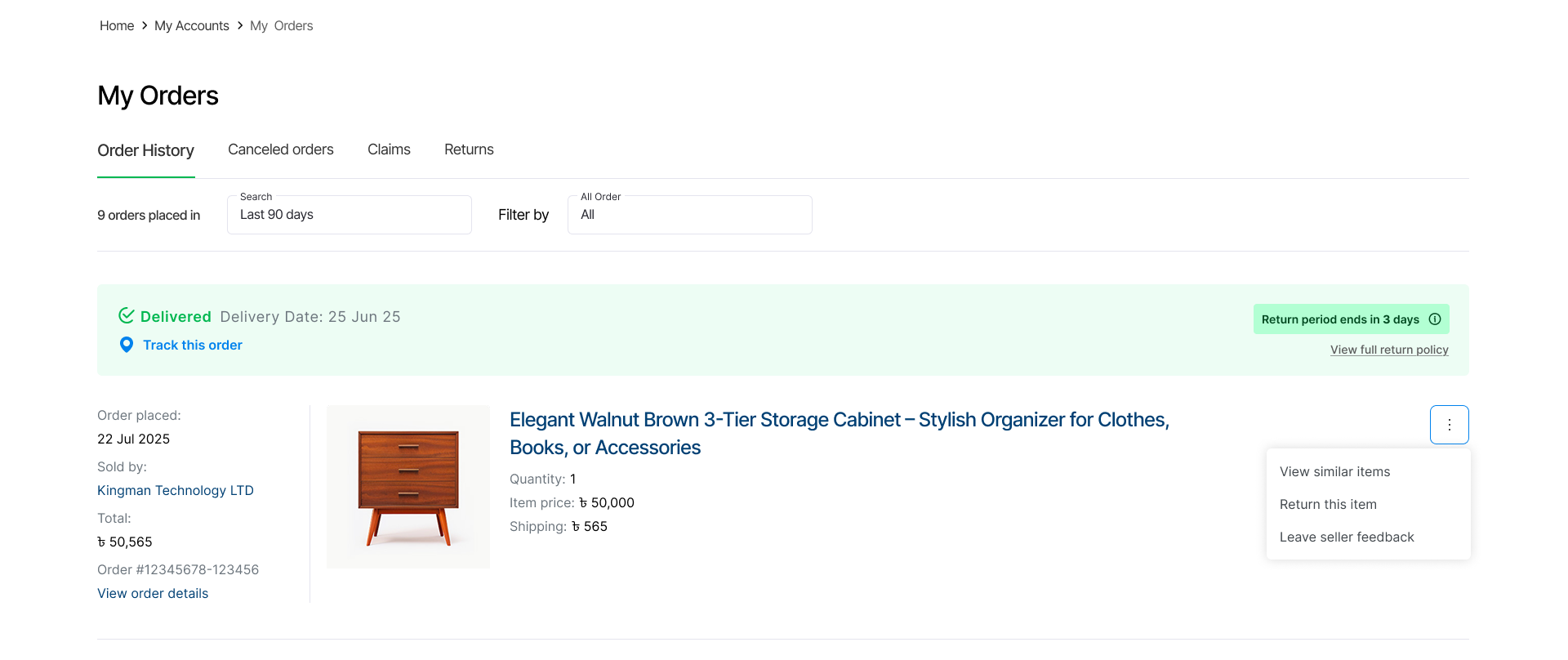
The return action was accessed from the three-dot menu on the order screen in the first prototype iteration.
S1-P1 repeatedly searched for a return option before the moderator directed attention to the menu. In the post-task discussion, the participant said that a direct return button would have made the action easier to identify. S1-P3 similarly described the placement as difficult for a new user and suggested a visible “Return this item” action.
The difficulty therefore did not arise from the absence of a return function, but from difficulty identifying how to enter the recovery process. Iteration 2 presented the return action more explicitly. Study 2 participants commonly located the route and proceeded into reason selection and subsequent steps, with some contrasting this visibility with experiences in which return functions were hidden within menus.
The corresponding Study 2 return-entry arrangement is shown in Figure 2.
Figure 2. Study 2 return-entry screen
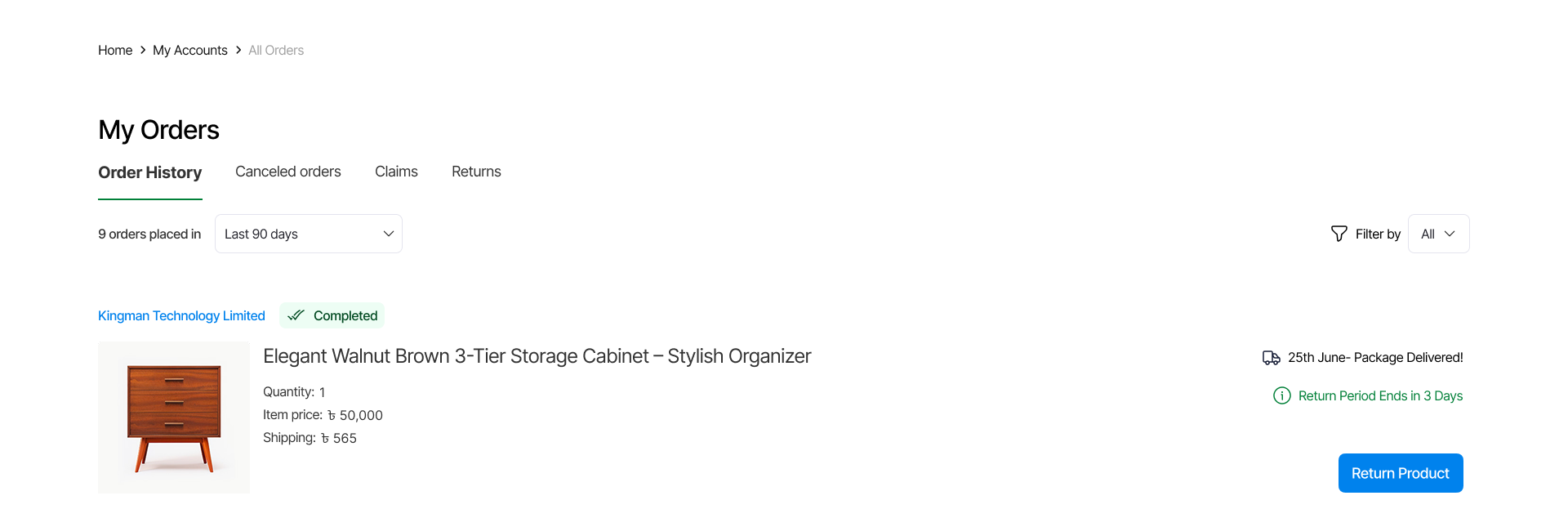
The second prototype iteration presented a visible “Return Product” action directly on the order screen.
These observations do not establish that Iteration 2 caused higher confidence, but they show that the existence of a recovery option was distinct from the discoverability of its entry point.
3.3 Recovery Required Understandable Action and Evidence
Once participants entered the return process, attention shifted to what they were expected to do and what information they needed to provide. The prototypes included reason selection and, depending on the interaction state, description and image-upload options.
In Study 1, some participants required clarification about particular controls or messages. In one session, a message associated with the selected return reason was not perceived until the moderator drew attention to it. This showed that explanatory content could be present without supporting the task if its relationship to the immediate action was unclear or visually weak.
Study 2 participants described reason selection, description fields, and photo upload as connected steps in documenting the problem. One participant regarded the description field as useful because a generic category might not communicate the defect clearly. Another viewed image upload as important because photographic evidence could support the customer’s position if the seller disputed the problem.
The Study 2 return-request interface is shown in Figure 3.
Figure 3. Study 2 return-request screen
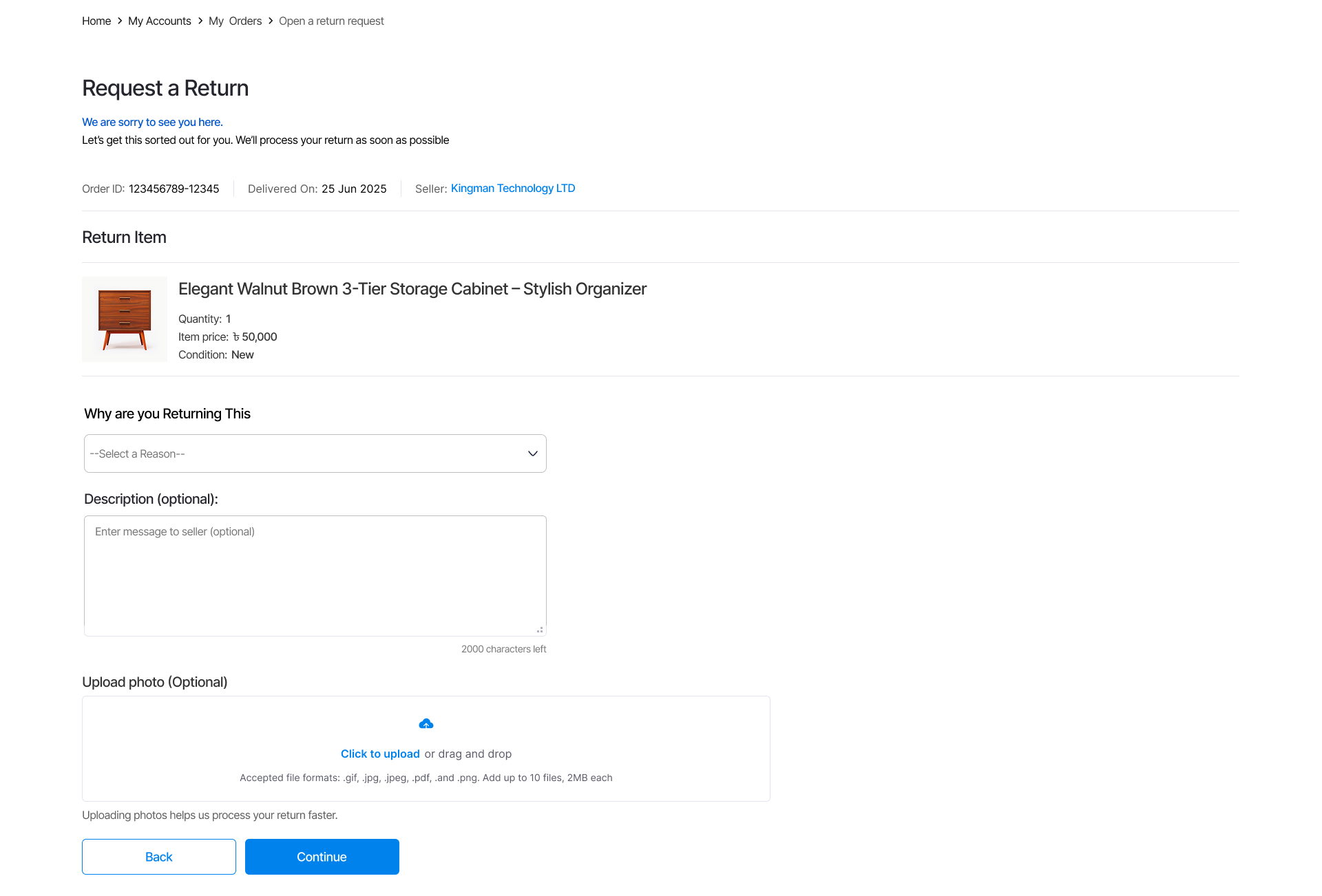
The return-request screen presented reason selection together with fields for describing the problem and providing photographic evidence.
The evidence also revealed two different evidentiary needs within recovery. Study 2 participants discussed evidence supplied by the customer, such as photographs or descriptions. In Study 1, S1-P5 raised a different concern: the participant was reluctant to release the product without proof of collection and wanted a return slip or pickup receipt. This was a distinctive rather than widespread requirement, but it illustrates that evidence may be relevant both to the customer’s claim and to confirming that responsibility for the returned item has transferred.
3.4 Product Transfer and Financial Resolution Had to Be Anticipatable
Participants also evaluated what would happen to the physical product and the associated payment. Pickup arrangements, refund destination, and expected timing were central to these judgments.
In Study 1, some participants initially did not understand whether they were expected to send the product themselves or whether the platform would arrange collection. Others wanted clearer information about when pickup would occur and what would happen after handover.
S1-P5 made this concern especially explicit. The participant accepted that collection might precede the refund but was uncomfortable surrendering the product while the financial outcome remained unresolved. Proof of collection and a faster or immediate refund were preferred. In this case, tracking and stated timelines did not fully remove uncertainty created by losing possession before receiving the money.
Refund destination also mattered. Participants considered whether money would be returned through bKash, card, store credit, cash, or another method. Preferences varied, but participants wanted to know where the refund would go.
Expected refund timing served a similar anticipatory function. Participants responded positively when refund information specified ranges such as one to three days or three to five days rather than leaving timing open-ended. Study 2 participants often referred to explicit pickup and refund dates when explaining why the process appeared understandable, although some still preferred faster refunds.
The core concern was therefore whether users could anticipate both product transfer and financial resolution, rather than preference for any single operational arrangement.
3.5 Unresolved Recovery Had to Remain Monitorable
Participants also evaluated whether they could determine what was happening after a return request had been submitted.
Iteration 1 already contained return and refund tracking information, but the presence of tracking did not always make the unresolved process understandable. S1-P1 initially failed to notice the progress indicator and questioned where tracking information was located. Only after further interaction and moderator clarification did the participant recognise the process bar as representing return progress. This showed that information could be present without providing reassurance if users did not perceive or understand it.
Study 2 represented the return process through more explicit states. Participants referred to stages such as return submission, pickup, processing, and refund completion, often linking these with estimated dates or refund time ranges. One participant contrasted this with a previous platform that showed only that a return request had been submitted; the more detailed tracker was considered useful because it showed what happened between submission and refund. Another participant described being able to see which step had been reached as reassuring.
The Study 2 submitted-return status interface is shown in Figure 4.
Figure 4. Study 2 submitted-return status screen
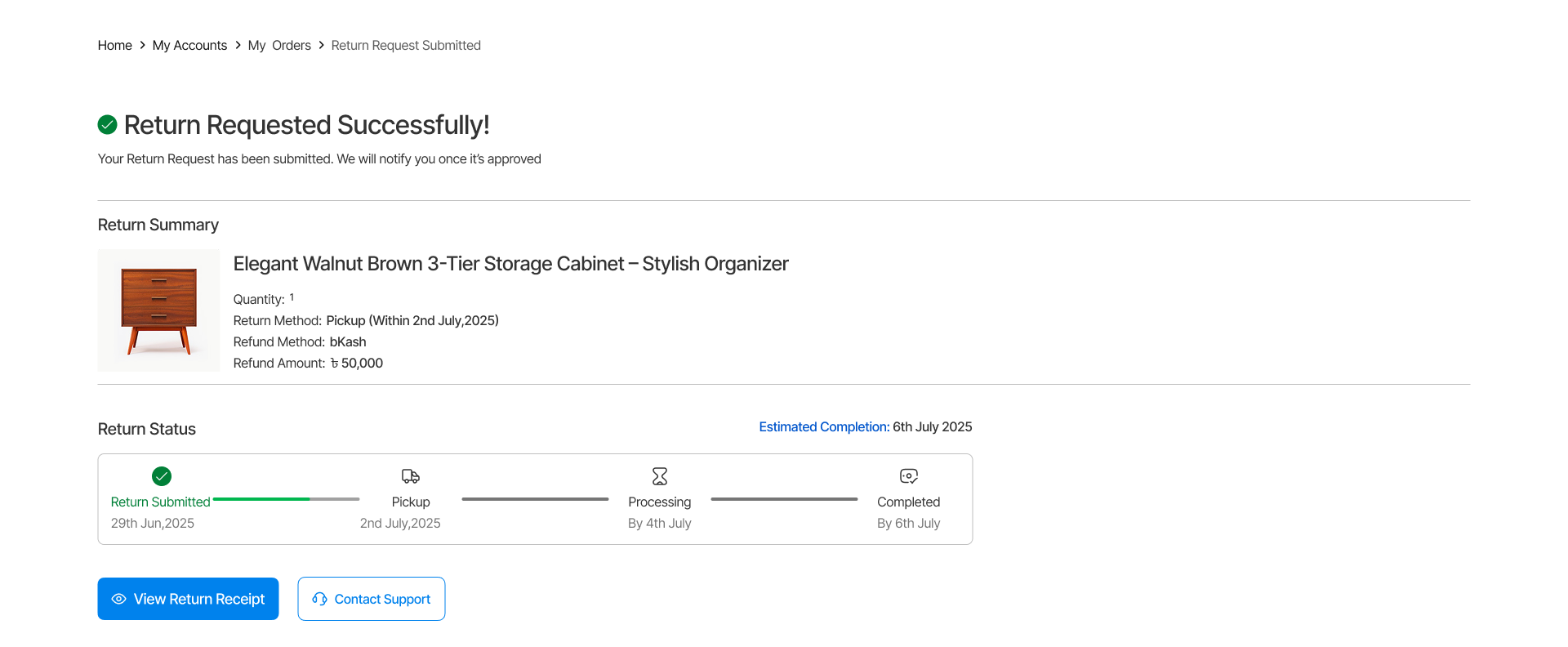
The submitted-return screen represented the current return state together with pickup information, refund method, estimated completion, return receipt, and support access.
Participants therefore used process-state information to determine whether the request had been recorded, which stage had been reached, and what was expected to happen next. Some also suggested greater pickup control or more direct access to support, although these concerns were less consistent than those around tracking and timing.
3.6 Legible Recovery Did Not Guarantee Credible Execution
Positive interpretations of the prototype did not necessarily produce unconditional confidence that a real service would perform in the same way. This boundary was especially visible in Study 2.
Participants often evaluated the Study 2 return flow positively because return entry, evidence requirements, pickup arrangements, refund information, timing, and status were easier to understand. Some nevertheless distinguished what the interface represented from what a real company would actually do. One participant said that greater confidence would depend on experiencing the service in practice, while another indicated that the platform’s commitments would become credible only if real-world execution matched what the interface showed.
The prototypes could therefore communicate how recovery was expected to proceed but could not demonstrate whether a seller, courier, or platform would fulfil the represented pickup, processing, or refund commitments. The evidence therefore concerns the interpretability and perceived credibility of represented recovery rather than the actual reliability of service execution.
Taken together, the findings show that return and refund recovery was evaluated as a connected interaction pathway rather than as a single policy or feature. Participants needed to identify where recovery began, understand required actions and evidence, anticipate product transfer and financial resolution, and follow the process while it remained unresolved. Making these elements more explicit could make the represented process easier to interpret, but interface legibility remained distinct from confidence in real service execution.
4 Discussion
4.1 From Recovery Availability to Recovery Legibility
The central finding is that the availability of a return or refund mechanism was not equivalent to users being able to understand recovery during interaction. In Study 1, return functions and process information were present, yet some participants had difficulty locating where to begin, identifying required actions, anticipating pickup and refund arrangements, or recognising how an unresolved request could be followed. Study 2 provided complementary evidence from a separate cohort: when the return and refund process was represented more explicitly, participants described identifiable actions, expected outcomes, and process states. Because the cohorts and prototype iterations differed, this pattern is not evidence of a redesign effect; it clarifies the interaction problem examined across the two evaluations.
Prior research has established the importance of return-policy characteristics, return handling, and return-shipping arrangements for consumer behaviour and buyer–seller relationships (Griffis et al., 2012; Janakiraman et al., 2016; Martínez-López et al., 2022). Qualitative work has also shown that online returning involves heterogeneous motivations and behaviours (Saarijärvi et al., 2017). The present study addresses a narrower question: when recovery is available, can users determine how it operates when they need it?
We use recovery legibility as a descriptive lens for this interaction-level problem. A recovery pathway became more legible when participants could identify where it began, understand what action or evidence was required, anticipate product transfer and refund arrangements, and follow the process while it remained unresolved.
Recovery legibility overlaps with, but is not equivalent to, service-recovery transparency, perceived control, or procedural justice. Legibility has previously been used in technology and design research to describe making technological processes intelligible to users (Robbins et al., 2021). In the present study, the idea is applied more narrowly to an e-commerce recovery pathway: whether users can identify how recovery begins, understand what they must do, anticipate subsequent transitions and outcomes, and follow an unresolved case. Service-recovery transparency has been conceptualised in terms of visibility and traceability (Choi & Kim, 2020), while perceived control concerns customers’ sense of influence over the recovery process (Chang, 2008; Guo et al., 2016) and procedural justice concerns evaluations of the fairness of recovery procedures (Sahaf & Fazili, 2024). Service-recovery scholarship has particularly emphasised perceived justice as a major explanatory tradition. These concepts may overlap in practice, but recovery legibility is used here only as a descriptive interaction-level lens rather than as a substitute for them or as a new general theory of service recovery.
The contribution is interaction-level evidence that recovery usability depends not only on whether returns and refunds are supported, but also on whether the pathway from problem to prospective resolution can be understood during use.
4.2 Transaction Assurance Is Not Recovery Assurance
Participants relied on different forms of reassurance when deciding whether to proceed with a purchase and when considering how a post-purchase problem would be resolved. Before or during checkout, they referred to product information, reviews, seller indicators, Cash on Delivery (COD), payment options, familiar couriers, order confirmation, and delivery tracking. Participants cited these cues when explaining why they were willing to proceed.
Some of this reasoning is consistent with prior work on perceived control in service recovery, where customer choice, information, and influence over the process can improve recovery evaluations (Chang, 2008; Guo et al., 2016). In this study, COD allowed some participants to defer payment until delivery, while courier familiarity, confirmation, and tracking made the prospective transaction easier to anticipate.
The return scenario changed the object of uncertainty. Once participants imagined receiving a damaged product, payment choice or courier familiarity could not answer whether they could initiate a return, what evidence was required, how the item would be collected, where the refund would go, how long it might take, or what information would remain available while the case was unresolved. A transaction could therefore feel sufficiently safe to enter while the recovery pathway remained difficult to interpret.
This distinction is descriptive rather than a two-factor model of trust. The study did not measure separate latent constructs of transaction and recovery assurance. More importantly, the stage-wise ratings do not show that trust simply deteriorated after checkout. The stronger finding is qualitative: recovery generated a different interaction problem, requiring information and feedback that earlier reassurance mechanisms did not provide.
4.3 Recovery as an Ongoing Interaction Pathway
Participants treated recovery as a process extending across connected states rather than as a single policy decision or submission event. Their reasoning concerned where recovery began, what action or evidence was required, how the product would be collected or handed over, where and when the refund would be received, how the unresolved request could be followed, and what confirmation or support would be available if the process did not proceed as expected.
These concerns should not be treated as a universal sequence or formal model. Platforms may combine, omit, reorder, or automate particular steps. Their analytical value is to show why isolated interface features did not fully account for participants’ judgments.
The dependencies between states were visible throughout the evaluations. A return mechanism could not be used if its entry point was not readily located. Once inside the process, participants needed to understand what information or evidence to provide. Submission then raised questions about product transfer and, in the distinctive S1-P5 case, proof that custody had transferred. Financial resolution created further expectations about refund destination and timing.
Recovery also extended beyond the user’s immediate action. Because returns and refunds can remain unresolved after submission or collection, participants used status information, estimated dates, and process stages to determine whether the request remained active and what should happen next. In Study 1, tracking information sometimes existed without being noticed or understood. Study 2 participants described the represented process states when explaining why the recovery pathway appeared understandable.
This interpretation complements returns-management and service-recovery research that treats recovery as an ongoing process involving procedural handling, communication, control, and progress toward resolution (Griffis et al., 2012; Guo et al., 2016). The interaction-design contribution is to show that users also need these service processes to be represented intelligibly while they unfold. In asynchronous digital recovery, the interface must communicate not just an eventual outcome but the relationship between completed user actions, the service’s current state, and what is expected next.
4.4 Representing Recovery Versus Executing Recovery
The study also distinguishes what an interface can represent from what an organisation can actually deliver. Participants could judge whether the prototypes made return and refund processes understandable, but they could not observe whether a retailer, seller, courier, or payment provider would execute those processes as shown.
This boundary was especially visible in Study 2. Participants could respond positively to visible return entry, evidence submission, pickup information, refund options, timing, and tracking while still qualifying their confidence in the service itself. Some indicated that greater confidence would depend on successful real-world experience or on the platform fulfilling the commitments shown in the interface. Such responses distinguish represented recovery from executed recovery.
This distinction is consistent with service-recovery research showing that actual return experiences and operational arrangements influence subsequent behaviour and buyer–seller relationships (Griffis et al., 2012; Martínez-López et al., 2022). A clear interface cannot substitute for timely collection, accurate processing, completed refunds, or effective resolution. Conversely, operational capability may remain difficult for customers to use if its procedures and states are opaque.
The study therefore separates the legibility of a represented recovery pathway from the reliability of operational execution. The former is examined directly here; the latter could not be evaluated through prototype interaction. Study 2 consequently shows that participants could understand the represented process, not that the process would necessarily produce successful recovery, stronger long-term trust, retention, or repeat purchase.
4.5 Design Implications
The findings suggest that return and refund design should be evaluated as an interaction problem, not only in terms of policy availability or backend capability.
First, return initiation should be discoverable where users are likely to need it. Study 1 showed that a return function located within a secondary menu could exist without being readily found.
Second, required actions and evidentiary responsibilities should be understandable. Where users must select reasons, describe problems, or upload photographs, the interface should make clear what is required for the request to proceed.
Third, product transfer and financial resolution should be predictable. Users may need to know whether collection will be arranged, when it will occur, where the refund will be sent, and the expected time to resolution. Preferences for particular methods or speeds differed, so the findings do not support a single operational prescription. They support making the applicable arrangement visible.
Evidence of handover may also matter when custody changes before a refund is completed. One Study 1 participant wanted a pickup receipt or return slip before surrendering the item. This was a bounded case rather than a widespread requirement, but it identifies a potential risk where customers otherwise have little evidence that responsibility has transferred.
Fourth, unresolved returns should remain interpretable after submission. The findings indicate that users may benefit from information showing the current state, what has already happened, what is expected next, and any relevant time expectation, rather than only a generic “request received” status. Tracking should therefore be assessed for whether users understand the state it represents, not merely for whether a tracker exists.
Finally, interface representation should align with service operations. Clear pickup, refund, and status information creates expectations that the underlying service must be able to fulfil. Where processes stall or diverge, access to support or escalation may become important, although the present evidence on recourse is thinner than that concerning the core return and refund pathway.
These implications are design questions rather than a universal checklist. Their broader value is to focus evaluation on whether users can understand what they can do, what has happened, what the service is expected to do next, and when resolution can reasonably be anticipated.
4.6 Limitations and Future Research
Several limitations bound the findings. First, participants interacted with prototypes rather than completing real purchases and returns. The study could examine how recovery was represented and interpreted, but not actual collection, dispute handling, refund completion, service delays, or organisational response. It therefore cannot show that a more legible interface improves operational recovery, long-term trust, repurchase, or retention.
Second, Study 1 and Study 2 used independent participant cohorts, and the prototype iterations differed in multiple elements. Between-study differences, including the higher return-stage rating in Study 2, cannot be attributed to particular design changes. Controlled or within-subject studies would be required to estimate such effects.
Third, the convenience sample comprised 33 adult Bengali-speaking online shoppers, mostly based in Bangladesh. The findings are not population estimates for Bangladeshi consumers and should not be treated as unique to Bangladesh. Their value lies in detailed interaction evidence rather than statistical generalisability.
Fourth, the 1–7 ratings were descriptive elicitation measures rather than a validated trust scale. They provide contextual indicators of confidence but not validated measurement of consumer trust or latent constructs.
Fifth, moderation sometimes included direct feature questions, procedural clarification, or explanation of interface states. Such responses were interpreted more cautiously than spontaneous breakdowns and participant-initiated concerns. Future studies could explicitly distinguish spontaneous, task-elicited, moderator-prompted, and post-explanation responses.
Finally, the study examined only the customer-facing side of recovery. It did not investigate retailer, seller, courier, payment-provider, or support operations. Future work should connect interface interaction with actual return cases, service logs, refund completion times, support records, and other operational evidence. Controlled prototype studies could isolate particular interaction problems, while field and longitudinal research could examine whether recovery legibility corresponds with successful resolution, subsequent trust, complaint behaviour, or continued platform use across different retail and service contexts.
5 Conclusion
This study examined how users interpreted post-purchase return and refund pathways during two sequential e-commerce prototype evaluations. The findings show that the existence of a return mechanism did not necessarily make recovery easy to understand or use. Participants needed to identify where recovery began, understand what actions or evidence were required, anticipate product collection and refund arrangements, and follow the status of the process while resolution remained incomplete.
The study uses recovery legibility as a descriptive lens for this interaction problem. Recovery became more legible when the represented pathway made its available actions, expected transitions, financial outcomes, and unresolved states easier for participants to understand.
The findings also distinguish the legibility of a represented recovery process from the reliability of its actual execution. A prototype can communicate how a return or refund is expected to proceed, but only operational experience can demonstrate whether pickup, processing, support, and refund commitments are fulfilled. Interface clarity can therefore support users’ understanding of recovery but cannot substitute for effective service delivery.
By focusing on interaction with the recovery pathway itself, the study extends discussion of e-commerce returns beyond whether return policies or services are available. It highlights the importance of examining whether customers can understand how recovery works while a transaction remains unresolved. Future research should test these interaction problems in controlled and production settings and examine how recovery legibility relates to actual service performance, customer outcomes, and different e-commerce infrastructures.
Funding
This research did not receive any specific grant from funding agencies in the public, commercial, or not-for-profit sectors.
Declaration of Interest
The authors report no competing interests to declare.
Data Availability Statement
The interview transcripts are not publicly available because they contain contextual and conversational information that could compromise participant confidentiality. Anonymised participant accounts supporting the reported analysis and aggregate descriptive trust-rating results are included in the article. The study did not include consent for public release of the interview transcripts.
Generative AI Use Statement
A generative AI tool was used as a supplementary aid during manuscript development, including source-level evidence comparison and verification. The authors reviewed the underlying research records, determined the final interpretations and claim boundaries, and take full responsibility for the accuracy, evidence, references, and integrity of the manuscript.
References
Chang, C.-C. (2008). Choice, Perceived Control, and Customer Satisfaction: The Psychology of Online Service Recovery. CyberPsychology & Behavior, 11(3), 321–328. https://doi.org/10.1089/cpb.2007.0059
Choi, J., & Kim, S. (2020). Development and Validation of a Scale to Measure Service Recovery Transparency: Focused on the Financial Industry. Korean Management Review, 49(5), 1323–1347. https://doi.org/10.17287/kmr.2020.49.5.1323
Das, L., & Kunja, S. R. (2024). Why do consumers return products? A qualitative exploration of online product return behaviour of young consumers. Journal of Retailing and Consumer Services, 78, 103770. https://doi.org/10.1016/j.jretconser.2024.103770
Ferdous, Z., & bin Ahsan, W. (2024). Customer Experiences with E-commerce Returns in Bangladesh: Effects on Satisfaction, Trust, and Loyalty. Userhub Journal. https://doi.org/10.58947/journal.nfqj67
Griffis, S. E., Rao, S., Goldsby, T. J., & Niranjan, T. T. (2012). The customer consequences of returns in online retailing: An empirical analysis. Journal of Operations Management, 30(4), 282–294. https://doi.org/10.1016/j.jom.2012.02.002
Guo, L., Lotz, S. L., Tang, C., & Gruen, T. W. (2016). The Role of Perceived Control in Customer Value Cocreation and Service Recovery Evaluation. Journal of Service Research, 19(1), 39–56. https://doi.org/10.1177/1094670515597213
Islam, F., & bin Ahsan, W. (2024). Strengthening Consumer Trust in Bangladesh’s E-Commerce: Factors and Strategies. Userhub Journal. https://doi.org/10.58947/journal.kpry56
Jafarzadeh, H., Tafti, M. M., Intezari, A., & Sohrabi, B. (2021). All’s well that ends well: Effective recovery from failures during the delivery phase of e-retailing process. Journal of Retailing and Consumer Services, 62, 102602. https://doi.org/10.1016/j.jretconser.2021.102602
Janakiraman, N., Syrdal, H. A., & Freling, R. (2016). The effect of return policy leniency on consumer purchase and return decisions: A meta-analytic review. Journal of Retailing, 92(2), 226–235. https://doi.org/10.1016/j.jretai.2015.11.002
Javed, M. K., & Wu, M. (2020). Effects of online retailer after delivery services on repurchase intention: An empirical analysis of customers’ past experience and future confidence with the retailer. Journal of Retailing and Consumer Services, 54, 101942. https://doi.org/10.1016/j.jretconser.2019.101942
Martínez-López, F. J., Feng, C., Li, Y., & Sansó Mata, M. (2022). Restoring the buyer–seller relationship through online return shipping: The role of return shipping method and return shipping fee. Electronic Commerce Research and Applications, 54, 101170. https://doi.org/10.1016/j.elerap.2022.101170
Oghazi, P., Karlsson, S., Hellström, D., & Hjort, K. (2018). Online purchase return policy leniency and purchase decision: Mediating role of consumer trust. Journal of Retailing and Consumer Services, 41, 190–200. https://doi.org/10.1016/j.jretconser.2017.12.007
Rashid, K. H., & bin Ahsan, W. (2024). User Trust in E-Commerce through Product List Pages, Detail Pages, Reviews, and Security Features. Userhub Journal. https://doi.org/10.58947/journal.dmvq89
Rintamäki, T., Spence, M. T., Saarijärvi, H., Joensuu, J., & Yrjölä, M. (2021). Customers’ perceptions of returning items purchased online: planned versus unplanned product returners. International Journal of Physical Distribution & Logistics Management, 51(4), 403–422. https://doi.org/10.1108/IJPDLM-10-2019-0302
Robbins, H., Stone, T., Bolte, J., & van den Hoven, J. (2021). Legibility as a Design Principle: Surfacing Values in Sensing Technologies. Science, Technology, & Human Values, 46(5), 1104–1135. https://doi.org/10.1177/0162243920975488
Saarijärvi, H., Sutinen, U.-M., & Harris, L. C. (2017). Uncovering consumers’ returning behaviour: a study of fashion e-commerce. The International Review of Retail, Distribution and Consumer Research, 27(3), 284–299. https://doi.org/10.1080/09593969.2017.1314863
Sahaf, T. M., & Fazili, A. I. (2024). Service failure and service recovery: A hybrid review and research agenda. International Journal of Consumer Studies, 48(1), e12974. https://doi.org/10.1111/ijcs.12974