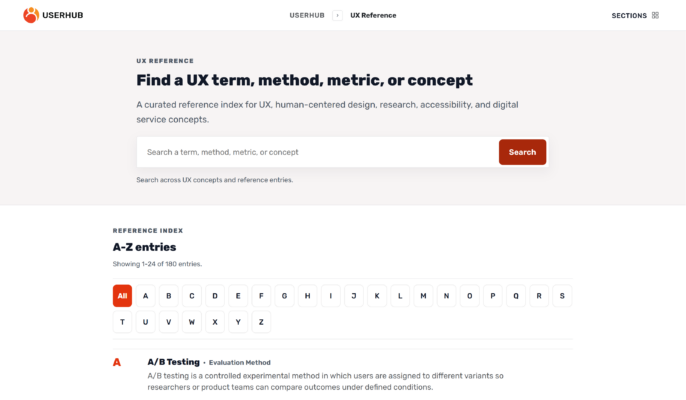
Userhub has added UX Reference to its website as a public knowledge system for UX, human-centered design, accessibility, research, and digital service concepts.
The reference is designed to help students, practitioners, educators, researchers, product teams, and digital service teams find, explain, teach, and apply commonly used concepts with greater clarity.
A structured reference for UX and digital service work
UX Reference brings together structured entries on concepts used across user experience, human-centered design, usability evaluation, accessibility, research, service design, design systems, and implementation quality.
Each entry is organized to support practical understanding. Entries may include a definition, plain-language explanation, use contexts, application guidance, interpretive boundaries, related concepts, sources, and citation support.
The first public version includes 180 entries and an A-Z index with search support. Example entries include Accessibility Governance, Task Success, and Design System Governance.
Why shared terminology matters
In UX, HCD, accessibility, research, and digital service work, teams often use the same terms differently. This can create confusion in learning, evaluation, implementation, procurement, reporting, and product decision-making.
Shared language helps teams discuss evidence, service quality, accessibility risks, user needs, design decisions, and implementation issues more clearly.
UX Reference is intended to support that shared language by making core concepts easier to find and easier to explain.
Connected to Userhub’s wider knowledge work
UX Reference connects with Userhub’s wider work in applied UX practice, professional education, and public knowledge publishing.
It supports UX Lab work by clarifying concepts used in evaluation, usability testing, accessibility review, product UX assessment, and digital service research. It supports Userhub Institute learning by giving students and practitioners a structured reference for course, assignment, and project work.
It also connects with Userhub Journal and Research Insights, where research outputs, applied reflections, and public knowledge resources are maintained as part of a public knowledge record.
Who can use UX Reference
UX Reference may be useful for students, UX and HCD practitioners, researchers, accessibility reviewers, content writers, product managers, implementation teams, and organizations working on digital services.
It may also support public-service, development-sector, fintech, healthtech, edtech, telco, platform, and enterprise teams that need clearer language when discussing user journeys, service access, usability risks, accessibility requirements, and implementation quality.
Explore Userhub UX Reference.