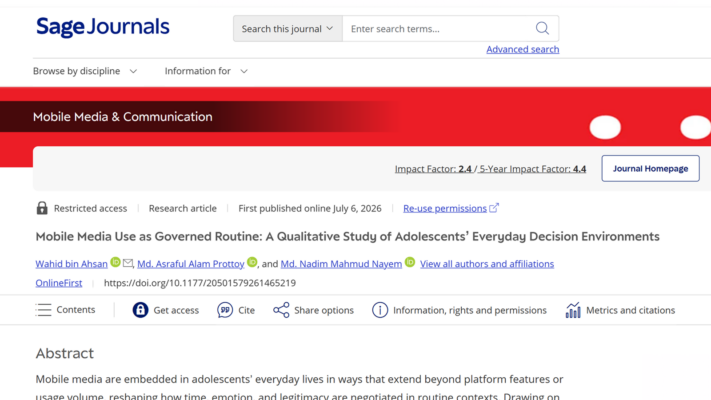
Userhub researchers Wahid bin Ahsan, Md. Asraful Alam Prottoy, and Md. Nadim Mahmud Nayem have published a peer-reviewed article in Mobile Media & Communication, a SAGE journal, on adolescent mobile media use in Bangladesh.
The article, “Mobile Media Use as Governed Routine: A Qualitative Study of Adolescents’ Everyday Decision Environments,” examines how adolescents’ mobile media routines are shaped by household governance, access conditions, time windows, shared devices, and everyday decision environments.
Peer-reviewed publication in Mobile Media & Communication
The article was published online in Mobile Media & Communication, an international peer-reviewed journal published by SAGE. The study contributes to research on mobile communication, adolescent digital wellbeing, and everyday technology use by focusing on how mobile media practices are organized within routine household and social conditions.
The permanent article link is available through the DOI: https://doi.org/10.1177/20501579261465219.
Studying adolescent mobile media use in Bangladesh
The study examines adolescent mobile media use in Bangladesh through qualitative interviews with adolescents and contextual adult participants. Rather than treating mobile media use only as screen time, platform exposure, or individual self-control, the article focuses on the everyday decision environments in which mobile media routines begin, expand, are governed, and end.
The analysis identifies several interacting mechanisms that shape adolescents’ mobile media practices, including temporal drift, affect regulation through content switching, household legitimacy governance, filtering divergence, access ecology, and sleep displacement as a downstream outcome.
Household governance, access ecology, and digital wellbeing
The article shows that similar platforms can produce different patterns of use depending on the conditions around the adolescent. These conditions include whether a device is personally owned or shared, whether use happens during school days or holidays, whether parents are nearby, and whether the activity is seen as study-related or leisure-oriented.
The findings suggest that extended mobile media use does not arise from platform design alone. It is shaped by the interaction of mobility, availability, household governance, supervision, and time-windowed access.
Contribution to Global South mobile media research
By situating adolescents’ experiences in Bangladesh, the study contributes to mobile media and digital wellbeing research from a Global South context. It foregrounds how shared devices, family expectations, study-related legitimacy, and everyday routines shape adolescents’ digital lives.
The article also supports Userhub’s wider work in applied research, digital service understanding, and professional education by connecting empirical research with questions of youth, technology, communication, and everyday decision-making.
Article citation and DOI
Ahsan, W. bin, Prottoy, M. A. A., & Nayem, M. N. M. (2026). Mobile Media Use as Governed Routine: A Qualitative Study of Adolescents’ Everyday Decision Environments. Mobile Media & Communication. https://doi.org/10.1177/20501579261465219
Read the article on SAGE Journals: Mobile Media Use as Governed Routine.